Saturday, 11 July 2015

Almost back in the muddy ditch

Nearing Isis Bridge among rowers, punts and trip boats
Yes, tonight we are within a few hundred yards of being back on the narrow canals. We are in Oxford, moored just after our final Thames lock, Osney. Along the quiet side street behind us stands a row of pretty terraced houses.
And they should be pretty – a two bedroomed one just sold for £695,000! For a step straight onto the pavement mid-terrace. That makes London look cheap. No wonder the young people of Oxford are camped in ramshackle boats up the canal.
It's been a pretty routine couple of days run up river to here. Having left our mooring at the wasp factory we headed for Abingdon, a particularly boater friendly town that offers a couple of miles of proper moorings that are also free.
The pretty riverside village of Clifton Hampden
The river followed a long, long anti-clockwise curve past the straggling village of Burcot, where the long lawns of ever larger houses swept gently down to the river. On the opposite bank a tractor was hay baling and had attracted a flock of at least twenty red kites who were circling waiting for unfortunate little mammals below to make a dash for safety. We've seen these wonderful looking birds everywhere on our trip but the sheer numbers here makes one wonder just what impact they are having on our native shrews, field mice and the like.
A flock of red kites stalked little critters in the field below

At Clifton Hampden we went through a rather handsome brick arched bridge, with the village church and cluster of thatched cottages nestled beside it. Beyond here the river enters the first of several artificial 'cuts' built to straighten out rather meandering stretches. First came Clifton and then Culham cuts with a lock at each, all making for a somewhat bland couple of miles.
At the end of the Culham cut we swung a 90 degree right and connected again with a wide main river that took us pretty much in a straight line to Abingdon, passing the old entrance to the Wilts & Berks Canal on the way.
Passing the old entrance to the Wilts & Berks Canal
We got there by lunchtime but already there was only one, Harry sized space left and we had to squeeze delicately in between two giant (and expensive) plastics while their owners looked on anxiously.
Abingdon is a pretty enough town – and the place where my first car, an MG, was built – but we've been here twice before so this time it was little more than a shopping and overnight stop.
This morning we got out of town before the sunny Saturday rush on the river got seriously under way. All the same, the day boats with their complements of boozing lads were already out and about – which must have scared some of the rowers from Radley College who were also busy on the water.
Nuneham House – now a meditation centre
Along this long, wide and pleasant but unmemorable stretch the stand out feature is Nuneham House, a Palladian mansion built in the 1700s and stayed in by Queen Victoria on her honeymoon. Amusingly it was unexpectedly inherited by Sir William Harcourt some years after he, as Chancellor of the Exchequer, had introduced death duties. By then it was dilapidated and the estate was short of cash for repairs. "I appear to have inherited a bankrupt estate" he told the agent who replied "well whose fault do you think that is?" It is now a spiritual meditation centre run by the Brahma Kumaris movement.
Sharing a lock with a crowded Salters trip boat
As we neared Oxford the river got even busier with canoes, inflatables, rowing boats, swimmers, small boats and then even punts and gondolas as we came into the city. At the other end of the scale we shared one lock with a huge Salters trip boat taking a couple of hundred passengers on a trip to Oxford.
Yes, everyone and their dog – including Seadog Brian – was out enjoying the sun. The Thames might be a river flowing through some of the most affluent real estate in the land but the river is utterly democratic. Everyone and anyone can mess about on it.

Friday, 10 July 2015

More walking than boating

The view up the picturesque main street of Dorchester
We certainly didn't repeat the previous night's mistake yesterday: we were tied up before lunch on our bankside mooring. It wasn't hard; we only came two miles upriver, went through Day's Lock – home of the World Pooh-sticks Championship – and moored.
It was going to be a walking day. We were going to explore Dorchester, a place we'd managed to miss on previous Thames journeys, and then walk up to the 'Wittenham Clumps', the pair of hills that dominate the otherwise flat local countryside.
The Abbey and the old  River Thame bridge tollhouse
Curiously, Dorchester-on-Thames isn't actually on the Thames at all: it's about half a mile away and sandwiched between the Thames and its tributary, the Thames, which meets its big brother here.
What a delightful little place it is. Since being by-passed in the 1980s, it has become a picturesque sleepy hollow with a rich variety of houses and inns, from medieval up to modern, from tiny cottages to substantial pads.
Sweep the main street clear of modern cars and it immediately becomes the sort of village beloved of English detective story writers since Agatha Christie and her Miss Marple. Indeed fans of Midsomer Murders will certainly recognise it as it was a regular filming location for the tv series.
Dorchester also has a 12th century Abbey, or rather an Abbey church as the rest of the abbey buildings disappered after Henry VIII's dissolution. It is now an oddly cavernous parish church in this modest village.
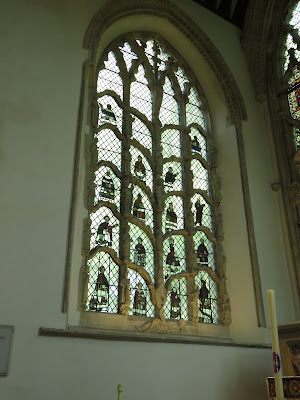
The spectacular tree of Jesse Abbey window
It has some fine elements, including the remarkable 'Tree of Jesse' window that incorporates stained glass in between the ornate branches of a finely carved stone tree, wall paintings and impressive carved tombs. Our favourite piece, though, was the stone to one Sarah Fletcher who died of 'excessive sensibility'.
Sarah Fletcher died of 'excessive sensibility'
The presence of an Abbey is a clue to Dorchester's importance in history. Situated on a sweeping bend in the Thames and with the Thame on its other side, the Romans saw its strategic value and built a settlement there. Later, in Saxon times, it briefly became the capital of Wessex.
However there were even older settlements outside the village. One of the Wittenham hilltops was an Iron Age fortress while lines of curious ditches and hillocks by the river below it are evidence of an Iron Age township.
The village remained a busy and prosperous place, serving as a major coaching stop on the main road to London (hence the fine coaching inns), but gradually declined until by the 1950s it was a poor and deprived place, the small houses without even proper drainage. Hard to imagine that, when these days a two bedroomed bungalow here will cost the thick end of half a million quid.
We found out all this in the very informative and friendly little village Museum, housed in what was once the local grammar school next to the Abbey. They also do an excellent tea and cakes by the way!
The jogging club overtakes us on the hill climb
After a particularly hot day we left our assault on the Clumps until after dinner. It's a steep, steep climb up from the riverside and as we puffed up it we were overtaken by a pack of local runners out for a training session. Even some of them were struggling by the summit.
I'm afraid the Harry crew weren't quite as fit as them
The rewards were absolutely stunning views all around (blighted only by the monster that is Didcot power station). The hills are a geographical freak; the land in every direction is flat for miles which makes them a spectacular vantage point.
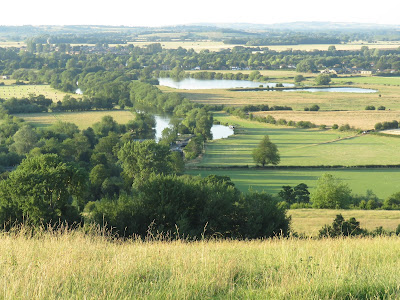
Worth the effort, though, for the stunning vistas
Then it was downhill and back as the sun set a fiery red in the distance and time for a relaxing beer.
This morning we woke up to discover wasps were busy building a nest in a bankside hole beside us so we skidaddled quickly before they decided to remove us themselves!


Wednesday, 8 July 2015

The one that – nearly – got away


Reeling in a monster from the deep
We had been mooring in Goring and things were somewhat boring – until a sudden gust of wind blew Seadog Brian's bean-bag bed off the deck and into the river. Fortunately he wasn't on it at the time.
All seemed lost as the capricious wind teased it further away from my boathook. Then the fisherman on the boat moored behind us decided to test out his casting skills and after a couple of false starts, had it hooked and reeled to the edge. Brian was very grateful – or would have been but he was already curled up asleep on our bed instead.
That's about as exciting as things get in Goring. It's an odd little spot, undeniably picturesque yet hard to love as it positively reeks of the sort of affluence which ordinary folk can't imagine.
Glass and steel homes are almost commonplace in Goring
You only have to look at the huge Thames-side houses: there are no less than three massive ultra-modern glass and steel creations, several others where ostentation was clearly more important than looks and yet more that are clearly still 'old money'. Oddly, among all this, the huge mansion south of the village that was semi-derelict when we came through two years ago still lies abandoned.
The very sorry for itself mansion outside Goring
If you can't afford a Huf House, get a glass summerhouse
There's even an Italian restaurant on the riverside outside the Goring called 'Rossini at the Leatherne Bottel' which seems to encapsulate pretension in a title. It might be good but you know it's going to be a) pricey and b) full of people you wouldn't want to share a dining room with.
A pretty little classic wooden boat at Goring
There are some nice boats, though, one or two classic wooden ones and, on the visitor moorings, a Piper Dutch barge we were very envious of which the owner took delivery of only last week.
Not our cup of tea, then, though it is a geographically interesting spot. The Thames here passes through the Goring Gap, a glacial valley carved out in the Ice Age that now seperates the Chilterns and the Berkshire Downs. It was the meeting place between the ancient Ridgeway and Icknield tracks and an early crossing point on the river.
A fleet of Freemans at Sheridan's brought back memories
Lured by the Test Match we lingered too long over lunch and moved off a little late in the afternoon. It's six miles of isolated countryside beyond Goring, broken only by the base of Sheridan Marine, the Freeman cruiser specialists. The flotilla of the little cruisers there brought back fond memories of Five Plus Five, the Freeman 23 that was our first boat.
Not such fond thoughts, though, at the Wallingford town moorings we'd hoped to stop which were full and we found ourselves hunting for a space to stop as the evening drew in.
On the Thames you can generally find a mooring – if you're willing to pay for it. The Benson lock-keeper said we could stop there – for eight quid and leave when the lock opened for business at 8a.m. No thanks. We pushed our bows into various edges, all of which were too shallow and moved on to Shillingford where the hotel offered plenty of moorings for a 'modest fee', according to the Nicholsons Guide – which turned out to be £15! Finally at 7.30 we found ourselves a nice little quiet spot on a steep bank just upstream.


Tuesday, 7 July 2015

Woken by a very noisy dawn chorus

Moored at Beale Park on a sunny evening with no geese
Why do people feed geese? If they had a huge flock of them honking and splashing outside their bedroom window at 4.30 a.m. like I had today then I bet they wouldn't be so keen.
Why do they feed them? And pigeons for that matter? Swans and ducks I understand – I'm happy to feed a duck an occasional piece of something when we are moored up – but I just cannot understand why people continue to feed these birds that are nothing short of pests.
I don't mean just throw them a few leftover crusts, no I mean shovel industrial quantities of food into the water and onto the riverbank. For some reason, Asian families seem to be the worst. I understand that the swan has a significant place in the Hindu religion so I'll concede feeding those but pigeons??
Anyway enough of the ranting: I was pretty grumpy at 4.30 a.m. and I had only just got back to sleep again when it started raining heavily and I realised I hadn't put the cover on the engine chimney so I had to get up and go outside to do so, rather than risk getting water in the engine.
Fortunately, once the morning rain had stopped, the day was blustery enough to keep me wide awake at the tiller.
We haven't come far, just to the edge of Beale Park wildlife sanctuary between Pangbourne and Goring. That's partly because of the rain but also because we decided to stock up the galley at Reading Aldi before leaving. There aren't many shops between here and Oxford – and certainly no Lidls or Aldis in posh old Oxfordshire.
A pair of pretty old Severn tugs now on the Thames
There's a long run out of Reading before the first lock at Mapledurham where pretty much everything you can see is (or was) part of the estate that centred around Mapledurham House, one of the finest Tudor mansions in the country. Like a surprising number of these places it is still in the hands of descendants of the Blount family who built it. The house and the working water mill are only open to Joe Public on summer weekends and lie virtually hidden from view behind banks of trees to us humble passing boaters. You will have seen them in films and tv programmes like The Eagle Has Landed and Inspector Morse.
Hardwick House - the inspiration for Toad Hall
A mile upriver is the rather more elegant Hardwick House, which glories in its elegantly symmetrical setting just back from the river. Queen Elizabeth I stayed here and, seemingly, Kenneth Grahame used it as his inspiration for Toad Hall and its then owner in 1909, Charles Day Rose, as a model for Mr Toad.
The present owner is his descendant, Sir Julian Rose and, as toffs go, seems a jolly good bloke. He started as an actor, took over the estate when his father died and changed it into a pioneering organic farm. He has opened up the estate forests for a young offenders project and lets out cottages at affordable rents to local people. He is now a leading 'green' campaigner.
Alpacas that have swapped the Andes for the Thames
A little further we came upon another pioneering farming venture – fields of apacas grazing. Bozedown Alpacas breeds these South American animals which are becoming popular here for their easy temperaments and fine fleeces.
Bulky Edwardian piles line the river at Pangbourne
We went under the Victorian iron toll bridge which allows motorists to venture between Whitchurch and Pangbourne for a 20p fee and on past another line of the grand but rather bulbous Edwardian houses that dominate the Thames-side scene along its home counties route. Oddly, with a main road and river in front and a railway behind, these huge piles have virtually no gardens.
House-watching is one of the fascinations of cruising the river – everything is here from ultra-modern glass and steel Huf houses down to little tumbledown timber cabins that are probably still worth a few hundred thou simply by virtue of their location.
Tomorrow we'll head through Goring, where money really is no object when it comes to building a flashy Thames-side home. Tonight though it's been kingfisher spotting in the beautiful, tree swathed countryside.


Monday, 6 July 2015

Goodbye K&A, hello River Thames

Welcome to the Thames and our first big plastic cruiser
After 100 miles, 104 locks and gawd knows how many swing bridges, today we left the Kennet & Avon at Reading and turned upstream on the Thames.
£61the poorer for a week's Thames licence, we are heading for Oxford and from there it's back onto the narrow canal system.
Last night's quiet mooring seems a long way away
From last night's idyllic middle-of-nowhere mooring we made easy work of the eight miles and as many locks into the town, including one of the two surviving turf sided locks that were originally found all along the canal here.
The Kennet, largely gently winding river and occasionally shallow, straight canal, manages to hide itself completely from the urban sprawl of Reading; water meadows forming an effective buffer to the southward spread of housing from the A4.
The eccentric and awkward old turf lock
Noise briefly intruded as we went under the M4, then it was back to water meadows and nature reserves. Only after Fobney Lock did the town finally reveal itself and then the run in is a pleasant one, along the bottom of small private house gardens, each of whom has made the most of their little piece of waterfront.
Our performance at the Oracle Centre begins
And the back up act is a dinosaur themed crazy golf course
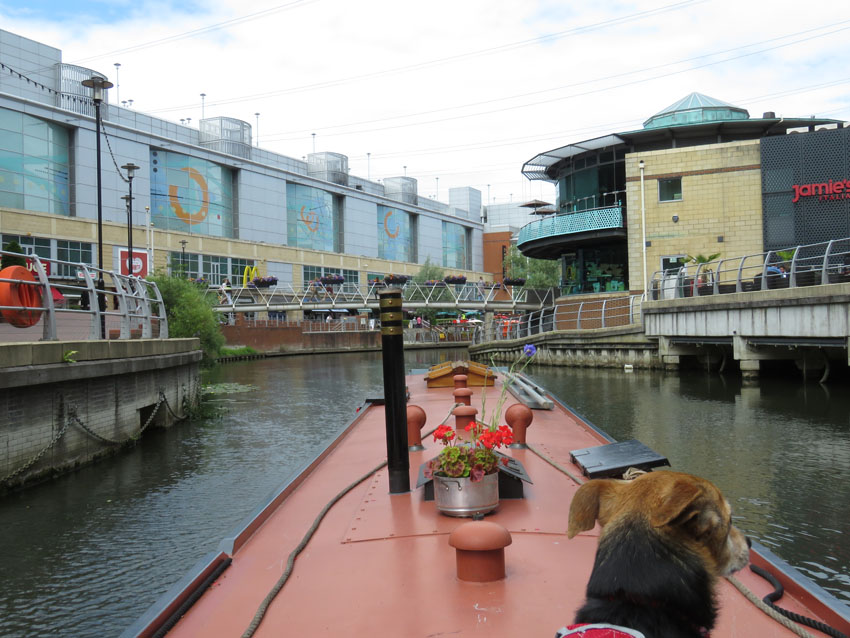
After that the run through the Oracle shopping centre would come as quite a shock if we hadn't done it twice already. Even so, it's still an eye-opener. Go round a bend and, suddenly, we are performers in Reading's little Truman Show, gliding through the middle of the centre past shoppers sipping their Starbucks or chewing on their Zizzi pizzas. There's no stopping for us boaters – we are just the floating version of street theatre. And the show has got even more weird since our last trip: there's a dinosaur enclosure (yes, honestly) with plastic dinos showing their plastic teeth as they lurk between plastic boulders. Only as we whizzed past did we realise it's all a crazy golf course.
I should have mentioned that there's a brief preamble to all this. We have to go through the shallow County Lock, stop at a traffic light, press a button and wait for the Green since the Oracle length is fast flowing, narrow and quite shallow.
Reading doesn't seem to have changed a lot in the last couple of years; it's still a charmless sort of place and grows increasingly shabby as we near Blakes Lock, the exit from the canal and the first official Environment Agency controlled lock.
Working the old Thames lock but where is my uniform?
There was no Thames lock-keeper on duty when we arrived though; it was diy. Not that I minded; I love working these old, manual Thames locks. They are big yet smooth working and as I twirl away on the ship's wheel style paddle control and pull the gate closed with the ingenious hooked pole, I feel that I really ought to be wearing an old style Thames Conservancy peaked cap and blazer.
Out, then, onto the Thames and the section by the riverside Tesco looks even shabbier than ever – more hippy wrecks on the island across the river and few visiting cruisers or narrowboats braving the somewhat ramshackle Tesco moorings.
A new pedestrian bridge takes shape across the river
We plodded on, past a fine new pedestrian and cycling suspension bridge that's being built across the river, and to a stop just upriver in the posh suburb of Caversham where we can look at the big houses and watch the mega-cruisers charge past.


Sunday, 5 July 2015

Game for a laugh

Newbury Lock, with its unique lever-operated paddle gear
After today I think I have a good idea for a new BBC tv gameshow. Get two teams of five intelligent people, put each in a 70ft narrowboat and ask them to perform tasks of increasing complexity while travelling along together – finishing off with going down a lock and turning round at the bottom.
Now there is a potential Channel 4 alternative – have a team of ten men (dressed as pirates) and a team of ten women (in skimpy sailor's outfits), give them multiple crates of beer and wine and watch them get increasingly idiotic as the day wears on, culminating in one or more falling in.
Personally, though, I think that's rather crude. I prefer the subtlety of the BBC version. The contenders have to be intelligent – bankers, doctors, marketing types – and the judging panel (get this) is a couple of middle aged housewives.
We saw the finale of the pilot show this afternoon: two such boats had to drop through the lock after Aldermaston Wharf, turn in the winding hole below and come back up the lock to return the boats. Apparently that's one of the stipulations of the hire operator there.
Their antics were beyond hilarious. They got one turned reasonably okay but then that completely blocked the winding hole space for the other boat when it tried the manoeuvre.
"Oh dear," said our judging houseswives on their canalside bench. "Why didn't they just take one out, turn it round and go back in the lock, then do it with the other one." You're absolutely right, judges. Zerol points for both teams.
Memorial plaque at Newbury Lock
It's been that sort of day. We've done 13 locks (and a few swing bridges) in ten miles to take us to a nice bankside stop beside a peaceful cow meadow on the edge of Theale. And something has been happening most of the time.
Newbury Lock, first of the day, is the official boundary between the original canalised River Kennet to Reading and the stretch from Newbury to Bath which joined it 60 years later. There's a plaque to record as much at the lock.
The day had started quietly enough in the company of a competent pair on their smart little 50 footer. Except that the lady lockie from that and myself chatted our way into B&Q carpark instead of the next lock! Busily talking we had missed the bridge taking the towpath to the other side and had to retrace our steps.
Serious flooding of the towpath near Thatcham
Bulls Lock, which claimed us in major league getting stuck issues both ways last time, was a pussy cat today but a couple of miles further on, strange things were happening at Monkey Marsh Lock in Thatcham. Water was pouring out of the Kennet and flooding the towpath. And I mean 'pouring' and 'flooding'. Clearly there was a serious problem at one of the many weirs. Harrywoman did her boating duty and phoned C&RT to alert them.
Our travelling companions pulled a flanker on us here: we'd come upon another narrowboat waiting for the lock and they waved us ahead to partner this one. "We are stopping soon; you go on."
Why Thatcham's lock is so big and oddly sided I can't say
I soon realised why: the boat ahead was full of Ranger Guides who spent their time singing, texting and – occasionally – boating. Fortunately after two locks they moored for lunch and we went on largely alone for the rest of the day, via the weird wibbly-wobbly sided giant lock at Aldermaston, a refuelling stop at the Wharf and the final antics at the next lock.
The Kennet here has moments of rare beauty
Not so much a sidestream at Towney Lock, more a Niagara
In between the entertainments we have traveled a rather lovely section of waterway, often among tree lined meadows, at times wandering, river fashion, through thick woods. With so little recent rain (in this area anyway) the current has been pretty benign, though we been past a few strong side weirs that could have caused us a few gameshow moments of our own. But, fortunately, not today.


Friday, 3 July 2015

Stop start boating

A familiar mooring style for us on the shallow sided canal
It's seems to have been a long week. It's certainly been a hot one – and a tiring one too.
This is a very different canal from the one we were travelling west of Caen Hill. Now we have been running through a gentle, tree lined valley cheek by jowl with the railway line and a series of rivers – as well as frequent WWII pillboxes since the canal was a 'last ditch' line of defence against German invasion forces that might be moving northwards from the coast.
WWII pillboxes still stand on the north bank of the canal
So, instead of flights of locks lifting us up or setting us down sharp gradients, we have a seemingly endless number of single locks adjusting the canal level a few feet at a time – and each of them a frustrating distance apart. Sometimes they are just too far apart to walk ahead and set, making for stop-start locking, while at other times they are just too near each other to make re-boarding worthwhile so it's a brisk ten minutes up the towpath for yours truly.
Thus it was that on Wednesday – the hottest day of not just this year but of many years – I found myself walking the best part of five miles to work us through the 12 locks between Crofton and Hungerford.
Not surprisingly we had a later start the next day! Anyway, Hungerford is a pleasant little spot to explore. It's quite obviously affluent in an under-stated 'old money' way, with antique shops, posh estate agents and classy gift shops lining the single shopping street. Yet it's solid, comfortable, easy on the eye and reassuringly one of those evergreen English country towns that defy change.
Yesterday, then, was just a short day on the boat, a couple of miles down to Wire Lock where we saw someone fly fishing on the adjacent River Kennet. We also found ourself moored rather closer than I would have liked to a wild bees nest and watched them make their way in and out during the evening. My lack of enthusiasm for creatures that sting was not helped by Harrywoman's comment that bees like to swarm at this time of year. Fortunately they appeared to be happy with their present home and didn't fancy taking over ours!
Here at Copse Lock the river joins the canal
The river got closer still today as we headed on to Newbury: in fact from now on it will be our constant companion as the canal is in large parts 'canalised' stretches of the river which weaves its way in and out of the navigation.
Pretty much all the way from Pewsey it has been clear that the K&A is suffering serious problems with bank erosion. It is natural sided with soft, soil banks and with hardly any steel piling. As a result mile after mile has been eaten away by prop wash on each side. The erosion has made the canal wider and shallower – depositing increasing amounts of silt into the water. A lot has been repaired with environmentally friendly natural materials and planting but there's much more still to do.
Repairs recently done to the eroded bankside
The tell-tale sign of a bank eaten away by engine running
Today we met a surveyor measuring up for another round of repairs. According to him one of the main causes of erosion is boats that moor out in the wilds for several days and run their engines in gear while moored to charge their batteries - the propwash eating deep into the towpath in tell-tale semicircles.
I can understand the problem but the trouble is that, frankly, the K&A here is absurdly short of decent moorings. Away from the short term, 24 or 48 hour visitor moorings (and there are precious few of these around here) the edges are generally shallow and usually a jungle which few can visit. If C&RT want boaters to avoid the fragile edges then they need to do more dredging and more robust edging to create more mooring opportunities.
Moored here at pretty West Mills on the edge of Newbury
Tonight we are in Newbury – the biggest town on the canal since Bath and a mix of attractive old buildings and ugly modern development. Shopping and sightseeing tomorrow and then we are on our way for we are now only 20 miles and 20 locks from the Thames.