Thursday, 18 September 2014

Thursday - early closing day for us

The handsome old paving at Slattocks lock
After the rigours of the past few days we declared today an early closing day and were tied up for the night by lunchtime. Or 'dinner time' as they say round here.
Truth is that we are having some r&r before the big push tomorrow: the nineteen locks that will take us down into the heart of Manchester. The stories on the canal grape-vine
make it sound like the front line: scrotes, rubbish, barely working locks, shortages of water and so on. We shall be wearing our body armour and hard hats when we set off early tomorrow. (Only joking, kids!).
Today was really quite pleasant. The flight of five Slattocks locks that began the day is as elegant a classical lock flight as you could ask for, with attractive stone bridges and old cobbled sett paving – which is as hard on the feet, though, as it is easy on the eye. When you go through locks like these you understand just why people worked so hard to get this canal back from dereliction.

Wide and deep – a first for the Rochdale
After Slattocks, where the water was running everywhere in abundance, over the locks and down the side streams, in contrast to the sluggish, low levels higher up the canal continued deep and wide through five more locks, ending after a sizeable bend – the first in many miles – at some deep water moorings (again, the first after for many miles) just by the River Irk aqueduct in a splendid rural setting, amid sloping hillsides and horse paddocks.
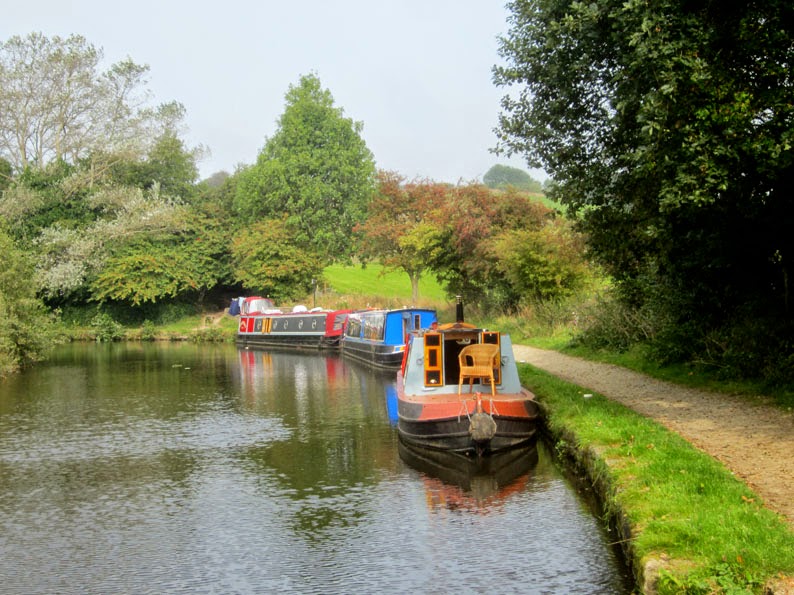
A couple of hours later the two Kiwi boats, Waiouru and Firefly which we've been trading places with virtually since Hebden Bridge, arrived from Slattocks and moored up behind and just round the corner below us is another boat that's come up from Manchester. Four boats – that must count as a marina round here!
Three in a line at Irk Aqueduct and on Harry the chair is out on the sun deck

Wednesday, 17 September 2014

Down and down we go

On our way - heading across the summit pound of the canal
We are on our way down. The man from CaRT came round this morning and told us that the summit was suitably refreshed overnight and we could be on our way so somewhat nervously we headed out along the three quarter mile stretch, knowing that if we did get stuck then we really were stuck.
The hills have very quickly given way to canalside mills and factories
We had teamed up with a couple on Nb Sentosa who had come up the locks behind us and agreed to stick together for the dozen locks down to Littleborough. If only it had been as straightforward as that.
It really is remarkable how quickly the canal changes after one has crossed the summit. The glorious hills of Yorkshire vanish abruptly and we are straight in amongst the 'dark Satanic mills' of Lancashire, the smoke stained gritstone of the canalside buildings emphasising their foreboding appearance.
Things started to go wrong almost straightaway. Harry went aground on a shallow stretch of the second pound and only a lengthy combination of pulling, poling and me running up and down between the locks flushing more water through got us free and into the next lock.
More problems after that: the next two locks had been narrowed by subsidence and could only take one boat at a time, rather than the normal two at a time, meaning each needed two lockfuls of water to work us both through. And two lockfuls out of a short pound means the second boat – us – goes aground. Cue more rushing about flushing more water down.
And a couple of locks later we were both in trouble again: I emptied the lock and discovered that both boats were sitting on the bottom and couldn't move. So...more flushing of water to get them away.
Fortunately that was the end of our issues for a while and we locked on down to Littleborough where we stopped for water and the others carried on to moor up. In the end, they struggled to find one and ended up sat out from the bank on the edge of town so we decided to carry on.
It's a long – by Rochdale standards – three mile lock-free stretch after Littleborough that ends at two locks in Rochdale. Lock-free it might be but it was still shallow, narrow and slow, with the odd shopping trolley and three piece suite for local colour.
Foreboding derelict industrial buildings line the canal in Rochdale
Rochdale is not an encouraging spot to pass through. The towpath is awash with litter, despite the best efforts of a CaRT volunteer who was doing his best to clear it, and the large,  derelict red brick mills and factories that surround the canal highlight the immense regeneration problems areas like this face. The old manufacturing industries are dead or dying and nothing yet has satisfactorily replaced them. On the edge of town we saw some regeneration, with tidy new houses being built on a cleared brownfield site, but so much still waits to be done.
And rubbish litters the towpath and the locks
On the positive side, the local people were universally friendly to what must have been a rare sight of a boat on their patch - kids, youths, pensioners and everyone in between had a cheery word or a  question to ask.
The first of the Rochdale locks gave us more problems as we found ourself once more sitting on the bottom of the emptied lock but by now we were getting practised at sorting this stuff.
You're never far from a decaying factory through Rochdale
Another slow run took us out of town, through a short tunnel under a motorway and then to the three Castleton locks. After the second of these we went through the skeleton of one of the original canal locks, now replaced and then under the M62 motorway. This M-way was built when the canal was derelict and no provision was made for the waterway: the solution was to re-align the waterway to make use of an existing culvert which now provides a narrow channel under the road to emerge into a new lock.
A clever re-design takes the canal under the M62 motorway
From here we found ourselves quite startlingly back in the countrside with cows in the fields and deep water beneath us. This took us to the top of the six Slattocks locks where we knew there was a mooring – and more importantly, a pub! It was a mooring but not for deep boats like ours: we are parked up with the bows three feet out from the edge and the stern ten feet out. But at least we got to the pub for pies and pints – after 18 locks they were much deserved.


Tuesday, 16 September 2014

Stuck in the middle

Stuck at the border – our stopping place tonight
The official boundary between the red rose and the white
Tonight we have been cooking in Yorkshire, we'll be sleeping in Lancashire and I am writing this right on the border between the two.
We are sitting at what – in a spy movie – could be a border crossing, a swingbridge bearing a large 'Stop' sign bars our forward progress beyond the last lock in Yorkshire.
We got a bit further but the water ran out so we had to reverse back
Not that there is anywhere to progress to. We are stuck. The canal beyond is closed; the lock gates padlocked. The summit level has run out of water. We reached here about 11 this morning, just after the last two boats had been shepherded through and the lock closed.
The summit level looks beautiful but water levels are very low
When will it re-open? Hopefully tomorrow morning after the water supply from the summit reservoir has replenished it. On the other hand, maybe not. The Rochdale has always been short of water. The reservoirs that supplied it were sold off when the canal closed and now it's been restored water supplies have to be paid for and are carefully rationed.
And the locks are padlocked shut until levels rise
Plenty of water and fine views up at Warland Reservoir
But we are not unhappy. There are far worse places to be stuck than on a sunny day in the glorious Calder valley with steep Pennine hills rising all around us. This afternoon we went for a walk up one of those hills. On the OS map it looked little more than a mile up to a reservoir at the top but, of course, it was an almost vertical mile and took a solid hour of climbing. It was well worth it – the reservoir is fabulous but the views stunning in every direction.
On the way up we had passed someone doing fencing; on the way down he was still at it and we stopped to chat. Turned out he owned the farm whose castellated, mock-castle wall we had seen as we approached on the canal. Dave and his partner Monica had returned from 25 years in Australia and used the proceeds from the sale of their beachside home to fund their dream project – to create an environmentally conscious farmstead at Warland Farm.
It's a bold scheme; they want to ensure that the land and buildings are brought into use in ways that restore the social value of the farm and benefit the local community as well as demonstrate ecological management of the farmland. To that end they've planted 11,000 trees to stabilise the steeply sloping land and, in due course, to help alleviate the flooding the local Calder valley has suffered. They are also creating an orchard, vegetable farm, blacksmith workshop and woodworking shop to bring craft skills back into use. "Come back and see us in a few years and see how we are getting on," said Dave.


Monday, 15 September 2014

Night and day action

Passing the extraordinary Great Wall of Tod
A group of youngsters were having a Saturday night impromptu festival in the canalside park at Hebden which is the sort of thing that makes moorers a little nervous of what might happen on the towpath later.
But the noise started to die away and things were quiet when we disappeared to bed at about 11pm. Until about 2am when we were woken by our guard dog Brian growling. Vicky heard a scuffling on deck and thought it was a rat – but it was a scrote busy trying to undo our front rope. "Oi! Clear off." she shouted and he did as fast as his drunken legs would go.
I re-tightened our knots and then we noticed that the Shire Cruisers hire boat had been more successfully 'scroted' and was drifting in mid-stream. I was able to gather its lines and have it partially re-moored before a sleepy face appeared from inside.
It's the first time in ten years boating that we've been un-moored and how ironic it should happen in a place so safe and boater-friendly.
The canal cuts a spectacular route through the steep sided valley
Marooned in mid-stream in a shallow pound
Next morning we decided it was time to move out and head for the hills. Not that we got very far, grinding to a halt in mid-stream after only a couple of locks. We came afloat after I flushed some water through from the next lock but after it happened a couple more times we were beginning to wonder about the sense of the whole attempt. Fortunately at that point the water situation improved itself and we motored steadily on to Todmorden where the lure of a Lidl and the promise of an interesting little town to look round saw us moor at the town mooring under a huge metallic sculpture of fishes. It looked impressive in daylight but spectacular at night when the street lights reflected wildly off the curves of the steel.
The handsome Lob Mill lock
Moored by Tod's aquatic sculpture and, below, the steel glittering in the night lights
Todmorden is an intriguing place. The outskirts look ropey with large areas either down at heel or demolished but some of the arty sheen of Hebden has rubbed off on the centre which has a little clutch of arty shops in its pretty streets. But its the striking architecture which sets Tod apart from many other Victorian towns, most notably its massive Neo-Classical town hall. Much of the municipal buildings - and a large Unitarian church were financed by the wealthy mill-owning John Fielden (who was also a radical campaigner to improve workers' rights) and his sons.
Todmorden's magnificent town hall
For a small town it also has some surprising, and quirky claims to fame. So here are some things you didn't know about Tod.
It's a centre of UFO activity - a police constable claimed he was abducted by aliens and a mysterious murder was said to have been carried out by aliens too.
Tod is the home of two Nobel prize winners: Sir John Cockcroft (physics) Sir Geoffrey Wilkinson (chemistry) both went to Todmorden Grammar School.
At one time, Tod had the biggest weaving shed in the world.
It used to have six railway stations.
It was only the second town in Britain to have buses.
The Yorkshire/Lancashire boundary originally ran through the middle of the town hall.
Keith Emerson of Emerson, Lake & Palmer; John Helliwell of Supertramp and Geoff Love the big band leader were all born in Tod – as was John Kettley the weatherman.
Even Tod's Lidl is in a handsome old stone building
That's enough of Tod for now! We left at lunchtime today – and went past the town's other remarkable feature 'the great wall of Tod', an immense, curving wall holding the railway embankment and built of some four million bricks.
As we headed on upwards the the locks were coming closer together and the surrounding hills more lumpy, trees giving way to scrubland and fields to coarse grass. But despite our fears there was no shortage of water; in fact the stuff was pouring over the top of some of the locks.

Grandma Pollard's famous fish n' chip shop at Walsden was sadly closed today
Rugged hillsides and more locks as we head on to the summit

We were travelling alone which slowed us down in the double width locks but we managed to keep a slender lead over a pair of Kiwi boats coming up behind us - competitive locking lives on!
We passed the famous Grandma Pollard's fish and chip shop in Walsden – the sign 'car park for 100 cars' shows how famous it is – finally stopping for the night in one of the longer pounds just below the summit where Mrs B was unlucky enough to unship the rudder from its bottom mount when she ran over some rubble while mooring. Fortunately  half an hour of crowbar work got it back into place and saved us an expensive call-out to our remote location.
We are now just six locks from the summit and then it will all be downhill - though to judge by the comments of a boater who'd just come up from Manchester, it might be downhill but it will be an uphill task.




Sunday, 14 September 2014

Footloose and footsore

The stunning ruined church at Heptonstall
Endless steep steps – tough for us but not for Brian
Bohemian Hebden Bridge held us willing captives for a couple of days. After exploring the town we pulled on our walking boots and headed for the surrounding hills.
Our target for the first day was the hillside village of Heptonstall, only a mile or so outside Hebden – but a mile at a 45 degree angle (or worse) to the horizontal. Three hundred years ago Heptonstall was the bigger of the two communities. This was in the pre-industrial revolution, pre-canal era when the village was at the crossroads of several major packhorse trails. It was also a centre for hand loom weaving – the original 'cottage industry'.
The secretive charms of hillside Heptonstall
Come the Industrial Revolution and the focus of weaving and transport shifted down the hill to Hebden Bridge, leaving Heptonstall marooned on its hillside. And marooned it still is: only the smallest of back roads runs through it. But the cobbled remains of those packhorse trails still remain, to make fine walking while the walking route out of Hebden up 'The Buttress' is a never ending, gut busting, lung bursting climb up cobbled pathways and steep, steep steps.
It is certainly worth the effort though. The road into the village turns from tarmac to cobble and the quiet stone houses, smoke-stained from the years or industry in the valley, look timeless. Built into the steep hillside, the little village squeezes houses into impossible spaces down little paths and alleys. It is very reminiscent of the sort of secretive hillside village you'd find in southern France. But behind the sleepy facade is a lively village with two pubs, a post office and plenty else going on.
Sylvia Plath, wife of Ted Hughes, lies in the churchyard
The centrepiece of the village is its amazing churchyard with its two churches. The original St Thomas A-Beckett church was badly damaged by storms in the 19th century and it was decided to replace it with a new one on the other side of the churchyard.
After the congregation had moved into the new one, the old church was left to fall into decay and it is now a spectacular ruin, made even more macabre by being surrounded by many dozens of old tombstones laid flat on the ground like a rough and ready patio across which you must walk to reach the church itself. Surrounded by its dark stone village houses, the skeletal church looks like a set from a Gothic horror.
We headed back into Hebden down a hill-edge trail that led us a steep, winding route to yet more steep steps (no easier going down than up) and finally back into the town.
Sheer rock face with climbers practising 
The next day one of our daughters came over to visit so we took her up to see Heptonstall by the same hill trail – except we lost the way and found ourselves at a steep rock face where climbers were practising their skills. Remarkably, here half way up the steep hillside were more cobbles leading up to steep stone steps around the edge of the rockface. What a monumental effort to have built them 300 years ago.
Even on a dull day, the views are stunning
After visiting the village we followed the path towards Hardcastle Crags, a National Trust owned stretch of hill and river valley. After plenty of uphill, it was good to be heading down via more winding paths through the woods, finally reaching the Hebden Beck below.  We then tracked this back towards the town, passing an extraordinary section where substantial stone walls had been built, presumably to keep the river in check when it is in flood.
Finally after three hours we were back at the boat and ready for some beer and pub grub at the excellent canalside Stubbing Wharf pub. We slept well that night – well at least we did for a couple of hours....ah but that's for the next post!


Thursday, 11 September 2014

Bohemians and boaters - that's Hebden Bridge

Moored up, well sort of, in Hebden Bridge
The Industrial Revolution turned the tiny hamlet of Hebden Bridge from little more than a packhorse crossing point on the river to a thriving hub of textile manufacturing. At the junction of two rivers it had water in plenty to drive the waterwheels of the newly mechanised mills. And when those mills became steam powered no less than 30 chimneys belched smoke into the air.
The picture postcard pretty centre of Hebden  - and its Bridge
All's so different now, the little town is still thriving but these days its picture-postcard-pretty stone buildings, river bridges and canalside attract thousands of visitors and have made the town a sought after spot to live, especially for what the guides coyly call a 'bohemian community'. You sense what they mean by walking the streets past the craft shops, wholefood cafes, ethical trading outlets and psychic therapy centres. Stir in a canalside that is full of boats, long term moored or visiting and you have a rich mix.
Distant hills as we pass through pretty Luddenden Foot
We arrived this afternoon after a gentle introduction to the Rochdale Canal, with just four locks in our six mile trip: further up we will be doing six locks a mile! Immediately out of Sowerby Bridge the canal disappears into the country as it winds a tree-lined route through the Calder Valley, with high hills starting to appear in the distance. The river, the canal, the railway and the road all weave together through this steep sided valley, though the canal traveller is suprisingly oblivious to the others.
The tree lined route out of Sowerby and one of several other boats on the move
The canal breaks out of the trees at the pretty village of Luddenden Foot and not long afterwards reaches the first pair of locks. They are certainly heavy, these Rochdale locks and slow, too, with 'scrote keys' locking every paddle. Water is a scarce resource on this canal and we don't want a bored youth emptying a week's worth by lifting a paddle, do we! The locks also fill fiercely and throw a single boat about unless you're careful; after the first couple we had honed a technique that got them filled reasonably fast without throwing the china around inside the cupboards.
There's a brief skirmish with industry after this as we pass the impossibly named Mytholmroyd. It looks like it ought to sound like someone gargling but is actually pronounced myth-em-royd (I think). More southern chuckling came at Broadbottom Lock. Actually broad bottoms would be handy to push most of these hefty lock beams and rather less chuckling when we encountered what looked like a road bridge but turned out to be a 25 yard tunnel with a 30 degree bend in it. You have to go in blind hoping that no-one's coming. Only when you're in do you see a glimpse of daylight from the other end. And no use sounding the horn; the traffic noise drowns it out.
But the twisted tunnel brings one into the edge of Hebden Bridge and just one more lock saw us reach the fine stone buildings of the town.
Mooring up was trickier: the canal sides are shallow and we are not so we ended up a good three feet out from the edge. Jumping on and off with Brian the dog for his late night toiletries will be fun.
It's a day off from boating tomorrow so we can explore the town and surroundings.


Wednesday, 10 September 2014

Ninety one locks in thirty three miles

In Tuel Lane lock, deepest in Britain
Well, we are finally here. At the start of what you could call the canal boater's Everest, the Rochdale Canal, the toughest of the three trans-Pennine canals; no summit tunnels, just endless locks up one side and down down the other.
The canal lay derelict from the early 1970s and only after a huge restoration effort was it brought back to life for boat traffic in 2002.
Base camp, as it were, for us was at Sowerby Bridge where the Rochdale branches away from the terminus of the Calder & Hebble. And what a magnificent terminus it is, too, surrounded by massive old stone warehouses that once dealt with the trans-shipment of goods between the two canals, all regenerated now into bars, restaurants and offices but still alive with boats and the base of the Pennine hire specialists, Shire Cruisers.
Leaving Lock One to begin the assault on the Rochdale
After travelling the length of the A&C alone, we met up with Nb Naomi May at Salterhebble for the last two locks on the A&C. In the morning sun the basin was even more charming and kept trimmed and litter free by volunteers, one of whom helped us through the lock.
Last lock on the Calder & Hebble and the first time we've had a travelling companion
One of the unsung volunteer heroes who keep Salterhebble so smart
At Sowerby we fuelled up in the basin while our travelling companions went onto the Rochdale – but not very far. When we arrived they were still puzzling over the padlocked gates of the first lock. Lock Three, Tuel Lane, on the canal is the deepest in Britain – 19ft 8.5 ins (three more than Bath deep lock) - and it's also approached through a short, curved tunnel under a main road. When the canal was restored this arrangement replaced two locks.
The magificent and bustling canal basin at Sowerby Bridge
There's a lock-keeper to operate things. He's not full-time so you have to book which we did, for 2pm. Then you wait for him to arrive and unlock the gates into Lock One and Two just below it. By 2.30 we were making phone calls and by 3.00 we were thinking of giving up. Finally at 3.30 a lockie turned up. "Sorry, I think someone possibly forgot". Never mind, it was a lovely sunny afternoon, time for teas, beers and a chat.
Tuel Lane lock is, indeed, deep – and even deeper if, like Mrs B you are way down in its depths – but with two boats in it and the lockie filling it steadily, the pair of us rose steadily up toward the surface.
Our companions pottered away out of Soweerby but we tied up on the first available rings after the lock.
Let the assault begin tomorrow; tonight it's to the pub! We headed off to the highly rated Navigation, a tucked away pub just back beyond the canal basin where we enjoyed one of the best pub meals we've had in a long time – and at a 'tenner for main and dessert' a delicious bargain too.